Performance Analysis of Highly Efficient Perovskite Solar Cell Using Numerical Analysis
Abstract
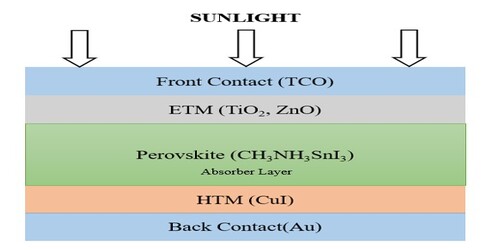
Research on perovskite solar cells (PSCs) has garnered significant attention due to their potential to offer superior power conversion efficiency (PCE), cost-effectiveness, tuneable bandgap properties, low recombination rates, high open-circuit voltage (VOC), ambipolar charge carrier transport, and broad-spectrum light absorption. We utilized the SCAPS-1D simulation software to optimize the performance of a PSC by employing zinc oxide (ZnO) as the electron transport layer (ETL), methylammonium tin iodide as the perovskite absorber layer, and copper iodide (CuI) as the hole transport layer (HTL). Our findings reveal that the thickness of each layer plays a crucial role in influencing the overall PCE of the PSC. Notably, the ZnO/CuI combination exhibited superior stability and degradation resistance compared to the TiO2/CuI combination. Through optimization, we achieved a remarkable peak efficiency of 24.13%, along with a VOC of 0.88 V, a JSC of 37.78 mA/cm², and an FF of 72.18%. These exceptional results were attained by carefully optimizing the thicknesses of the ETL and HTL, with both achieving an ideal thickness of 400 nano meters (nm) during the final optimization stage. The optimization process underscores the promising potential of PSCs for efficient solar energy conversion. Furthermore, the improved device demonstrates stability under illumination and exhibits promising characteristics in terms of VOC, JSC, FF, and overall efficiency.
Conclusion
Our study investigated the potential of lead-free perovskite solar cells (PSCs) employing copper iodide (CuI) as the hole transport layer (HTL) and zinc oxide (ZnO) as the electron transport layer (ETL). We observed a remarkable power conversion efficiency (PCE) of 24.13% for the proposed PSC when both the ETM and HTM were 0.050 µm thick [16] [17]. This finding highlights the potential of lead-free PSCs to achieve high efficiencies through careful material selection and optimization of device architecture. Our research contributes to the ongoing search for efficient and environmentally friendly alternatives to traditional lead-based PSCs. Replacing lead with non-toxic materials like CuI aligns with the broader goal of sustainable photovoltaic technology development. It is important to note that our results surpass the PCE of 20.5% achieved by previously reported lead-free PSCs employing NiO as the HTL (Ref. [insert reference]). This comparison underscores the potential of CuI as a promising candidate for efficient hole transport in lead-free PSCs. Further studies are necessary to explore the underlying mechanisms driving the observed performance. Investigating the charge carrier transport processes at the CuI/perovskite and ZnO/perovskite interfaces, along with the impact of CuI thickness and surface modifications, could provide valuable insights for further optimization. Additionally, exploring alternative electron transport materials beyond ZnO, such as NiO, ZnS, or CdS, could offer opportunities for further performance enhancement. This research demonstrates the potential of lead-free PSCs incorporating CuI as the HTL and ZnO as the ETL to achieve high PCEs (24.13%) exceeding those of previously reported lead-free devices. This finding paves the way for further research into optimizing device architecture, exploring alternative materials, and elucidating the underlying physical mechanisms for achieving even higher efficiencies and practical implementation of these environmentally friendly solar cells.