Urban Greening and Public Health: A Study on Heat-Related Illness in Low-Income Neighborhoods of Rajshahi City
Md. Sakib Zubayer, Lamia Ferdous · 10.63414/jeas.v9.n2.2025.36
Abstract

Urbanization and global climatic change have intensified urban heat stress and created immense challenges for global public health, especially for cities that are developing rapidly. In this context, cities such as Rajshahi, Bangladesh have recognized that Green Infrastructure will be central to reducing urban heat island effect as well as protecting health This research assessed the role of Green Infrastructure (GI) with respect to urban heat stress across three neighborhoods of Rajshahi City Corporation, Bangladesh. The research utilized a semi-structured questionnaire survey and filed observation checklist mixed methods design to assess household survey to collect necessary data, spatial information, and a logistic regression model to clarify the relationship between vegetation cover, household income and size, proximity to GI, vulnerable members, and perceived heat stress. Results demonstrated a significant, inverse relationship between perceived heat stress at various distances from GI (r = -0.72), indicating that households with higher income had less heat stress due to enhanced access to GI and/or adaptive practices. In Choto Bonogram, only 35% of respondents reported awareness of green infrastructure benefits; this contrasts with 58% in Chalk Kristan Para, which indicates a substantial knowledge discrepancy. Moreover, 72% of low-income respondents identified space to access vegetative shade as a barrier to utilizing GI. Mediation and interaction analyses indicated that access to GI significantly mediated the income–heat stress relationship and generated larger GI benefits for households with vulnerable individuals. These findings have important implications on the geographical distribution of GI and access for communities, the climate and GI education and engagement of communities, and the way planning processes in cities recognize the role of GI and the design and implementation of GI in rapidly growing urban areas.

Conclusion

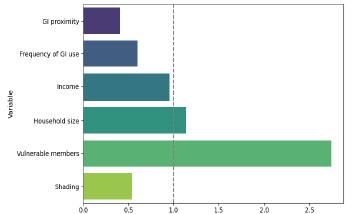
The research explored the association between green infrastructure (GI) and perceived heat stress in three neighborhoods in Rajshahi City Corporation: Chalk Kristan Para, Choto Bonogram, and Baze Kazla. Utilizing statistical modelling and qualitative elements, the study yielded a diverse and comprehensive understanding of how urban vegetation, socioeconomic status, and behavior, in the context of neighborhoods, influenced heat vulnerability. Every neighborhood indicated a consistent association between perceived heat stress and GI. Chalk Kristan Para had lower levels of heat stress with greater access to GI and a higher average income. The neighborhood Choto Bonogram with the highest perceived thermal discomfort had the highest density and lower income, as well as with little vegetation. Baze Kazla, in the middle of these two neighborhoods, with moderate GI access and perceived heat stress. Statistical modelling revealed an important negative correlation of heat stress with GI proximity (r = -0.72) and household income (r = -0.53). The current study therefore highlighted the protective nature of green cover and ability to economically buffer urban heat at the neighborhood level. Behavioral and perceptual insights distinguished differences in behavior functions. The residents in all three neighborhoods indicated that 1 PM to 4 PM comprised the most uncomfortable period. It was evident that residents in Chalk Kristan Para were the most likely (frequently) to use vegetative shade. The level of awareness regarding GI benefits and support for tree planting was notably higher in Chalk Kristan Para (58%) compared to Choto Bonogram (35%), where residents were similarly constrained spatially and not sufficiently aware of green solutions to launch community engagement. Logistic regression assured that distance to the nearest GI, the frequency of GI usage, and perceived shading, decreased the odds of reporting high heat stress levels, whereas the vulnerability of household members significantly increased the likelihood of reporting high heat stress. Mediation analysis confirmed that income decreases heat stress by increasing access to GI and showed an interaction effect in terms of frequent GI usage was beneficial especially for households with elder and chronically ill members. These findings have substantial implications for policy. First and foremost, to support equitable distribution and consideration of distributed green infrastructure (GI) in urban adaptation policy, particular attention needs to be placed on how we equip the most populous and lowest income neighborhoods with GI interventions. Secondly, and directly related to the first point, we need to emphasize public education related to GI with a community capacity building approach at the outset of GI interventions. Thirdly, it should be an important element for public policy - beyond just municipal guidelines - to incentivize vertical greening, rooftop gardening, and small-scale urban forestry, especially where open space is limited [10], [16].. Lastly, since low-income residents in urban centers are disproportionately affected by heat stress, urban planning efforts must prioritize these vulnerable populations through targeted green infrastructure expansion, equitable access to cooling, and inclusive design of adaptation strategies. In summary, this study supports our conclusion that GI is beneficial as a spatial management tool to reduce urban heat stress. However, GI effectiveness is reliant on considerations related to social inequities, spatial distribution, and community engagement/support. Therefore, GI is a potential foundation for creating inclusive and sustainable urban development when taken to a whole-system, contextually sensitive, inclusive and participatory approach to urban planning.

References
[1] P. A. Palanisamy, K. Jain, A. Tiwari, J. Zawadzka, and S. Bonafoni, “Evaluating The Persistence Urban Heat Island and Its Impact on Vulnerable Populations,” pp. 4032–4035, Sep. 2024, doi https://doi.org/10.1109/IGARSS53475.2024.10640655
[2] J. Pontius and A. McIntosh, “Urban Heat Islands,” pp. 119–133, 2024, doi https://doi.org/10.1007/978-3-031-48762-0_10
[3] S. Gao et al., “Urbanization-induced warming amplifies population exposure to compound heatwaves but narrows exposure inequality between global North and South cities,” NPJ Clim Atmos Sci, vol. 7, no. 1, Dec. 2024, doi https://doi.org/10.1038/S41612-024-00708-Z
[4] N. Osborne Jelks and J. C. Gonzalez, “Urban heat islands and associated health effects for vulnerable populations: Exploring data, <em>technology</em>, and community-engaged research to advance health equity,” Global Climate Crisis: Seeking Environmental Justice and Climate Equality, pp. 42–63, Jan. 2025, doi https://doi.org/10.4337/9781035308880.00007
[5] N. Sadat, H. Sheikh, and M. Asaduzzaman, “Evaluating Urban Heat Island Mitigation Strategies in Rajshahi, Using ENVI-Met: A Remote Sensing Approach, <em>” Journal of Contemporary Urban Affairs</em>, vol. 8, no. 2, Sep. 2024, doi https://doi.org/10.25034/IJCUA.2024.V8N2-15
[6] M. M. Patwary et al., “Heat stress perception, knowledge levels and health consequences of urban heat in major cities in Bangladesh,” Nov. 2023, doi https://doi.org/10.32942/X2060P
[7] A. T. Ekra et al., “Changes in human heat discomfort and its drivers in Bangladesh,” Urban Clim, vol. 55, May 2024, doi https://doi.org/10.1016/J.UCLIM.2024.101884
[8] J. Utzinger and J. Keiser, “Urbanization and tropical health - Then and now,” Ann Trop Med Parasitol, vol. 100, no. 5–6, pp. 517–533, 2006, doi https://doi.org/10.1179/136485906X97372
[9] S. Singh, P. Priyadarshni, and P. Pandey, “Impact of Urban Heat Island: A Local-Level Urban Climate Phenomenon on Urban Ecology and Human Health,” pp. 113–128, 2023, doi https://doi.org/10.1007/978-981-99-3006-7_5
[10] P. Herath and X. Bai, “Benefits and co-benefits of urban green infrastructure for sustainable cities: six current and emerging themes,” Sustain Sci, vol. 19, no. 3, pp. 1039–1063, May 2024, doi https://doi.org/10.1007/S11625-024-01475-9
[11] S. Pauleit, R. Hansen, E. L. Rall, and W. Rolf, “URBAN GREEN INFRASTRUCTURE: Strategic planning of urban green and blue for multiple benefi ts,” The Routledge Handbook of Urban Ecology: Second Edition, pp. 931–942, Jan. 2020, doi https://doi.org/10.4324/9780429506758-79
[12] E. Lemoine, “Evaluation of Green Infrastructure Benefits in Urban Areas in Paris,” Int J Environ Sci, vol. 7, no. 2, pp. 38–47, Jul. 2024, doi https://doi.org/10.47604/IJES.2737
[13] A. Almusaed, “The Green Areas Benefits Upon Urban Sustainability Role,” Biophilic and Bioclimatic Architecture, pp. 151–157, 2011, doi https://doi.org/10.1007/978-1-84996-534-7_11
[14] S. Khalili, P. Kumar, and L. Jones, “Evaluating the benefits of urban green infrastructure: Methods, indicators, and gaps,” Heliyon, vol. 10, no. 19, Oct. 2024, doi https://doi.org/10.1016/J.HELIYON.2024.E38446
[15] M. J. Nieuwenhuijsen, “Green Infrastructure and Health,” Annu Rev Public Health, vol. 42, pp. 317–328, Apr. 2020, doi https://doi.org/10.1146/ANNUREV-PUBLHEALTH-090419-102511
[16] N. H. Wong, C. L. Tan, D. D. Kolokotsa, and H. Takebayashi, “Greenery as a mitigation and adaptation strategy to urban heat,” Nat Rev Earth Environ, vol. 2, no. 3, pp. 166–181, Mar. 2021, doi https://doi.org/10.1038/S43017-020-00129-5
[17] T. Kjellstrom, “Climate change, direct heat exposure, health and well-being in low and middle-income countries,” Glob Health Action, vol. 2, no. 1, 2009, doi https://doi.org/10.3402/GHA.V2I0.1958
[18] V. Huber, S. Breitner-Busch, C. He, F. Matthies-Wiesler, A. Peters, and A. Schneider, “Heat-Related Mortality in the Extreme Summer of 2022,” Dtsch Arztebl Int, vol. 121, no. 3, pp. 79–85, Feb. 2024, doi https://doi.org/10.3238/ARZTEBL.M2023.0254
[19] C. Stephens and D. Brown, “Global Issues: Urban Health in Low- and Middle-income Countries,” International Encyclopedia of Public Health, pp. 581–590, 2025, doi https://doi.org/10.1016/B978-0-323-99967-0.00025-9
[20] J. C. Johnson and S. Galea, “Urban Health in Low- and Middle-Income Countries,” Making Healthy Places, pp. 350–365, 2011, doi https://doi.org/10.5822/978-1-61091-036-1_23
[21] S. Pauleit, A. Vasquéz, S. Maruthaveeran, L. Liu, and S. S. Cilliers, “Urban Green Infrastructure in the Global South,” Cities and Nature, vol. Part F337, pp. 107–143, 2021, doi https://doi.org/10.1007/978-3-030-67650-6_5
[22] M. Dennis, P. A. Cook, P. James, C. P. Wheater, and S. J. Lindley, “Relationships between health outcomes in older populations and urban green infrastructure size, quality and proximity,” BMC Public Health, vol. 20, no. 1, May 2020, doi https://doi.org/10.1186/S12889-020-08762-X
[23] M. L. McKinney and A. VerBerkmoes, “Beneficial Health Outcomes of Natural Green Infrastructure in Cities,” Current Landscape Ecology Reports, vol. 5, no. 2, pp. 35–44, Jun. 2020, doi https://doi.org/10.1007/S40823-020-00051-Y
[24] P. Suppakittpaisarn, X. Jiang, and W. C. Sullivan, “Green Infrastructure, Green Stormwater Infrastructure, <em>and Human Health: A Review</em>,” Current Landscape Ecology Reports, vol. 2, no. 4, pp. 96–110, Dec. 2017, doi https://doi.org/10.1007/S40823-017-0028-Y
[25] M. M. Rahman and J. Hasan, “Evaluating the Impact of Green Spaces on Urban Heat Reduction in Rajshahi, Bangladesh Using the InVEST Model,” Land (Basel), vol. 13, no. 8, Aug. 2024, doi https://doi.org/10.3390/LAND13081284
[26] X. Yang, X. Xu, Y. Wang, J. Yang, and X. Wu, “Heat exposure impacts on urban health: A meta-analysis, <em>” Science of the Total Environment</em>, vol. 947, Oct. 2024, doi https://doi.org/10.1016/J.SCITOTENV.2024.174650
[27] S. C. Sheridan and S. Lin, “Assessing Variability in the Impacts of Heat on Health Outcomes in New York City Over Time, Season, and Heat-Wave Duration,” Ecohealth, vol. 11, no. 4, pp. 512–525, Dec. 2014, doi https://doi.org/10.1007/S10393-014-0970-7
[28] P. M. Graffy et al., <em>“Methodological Approaches for Measuring the Association Between Heat Exposure and Health Outcomes: A Comprehensive Global Scoping Review</em>,” Geohealth, vol. 8, no. 9, Sep. 2024, doi https://doi.org/10.1029/2024GH001071
[29] W. Nicole, “Time and temperature: Changes in heat-related mortality over 27 years,” Environ Health Perspect, vol. 123, no. 11, p. A287, Nov. 2015, doi https://doi.org/10.1289/EHP.123-A287
[30] APN, "Factsheet Rajshahi City in Bangladesh," 2023. [Online]. Available: https://www.apn-gcr.org/wp-content/uploads/2023/06/Factsheet-Rajshahi-City-in-Bangladesh.pdf
[31] M. M. Rahman et al., "Developing Evidence on Water, Sanitation and Hygiene Facilities in the Climate Vulnerable Slums through WASH Poverty Index: A Case Study on Selected Slums in Rajshahi City Corporation, Bangladesh," 2021
[32] M. M. Rahman, M. R. Hasan, and M. A. Razzak, "Towards Green and Climate-Resilient Urbanization in Rajshahi City: Urban Growth Meets Climate Action in Northern Bangladesh," 2024